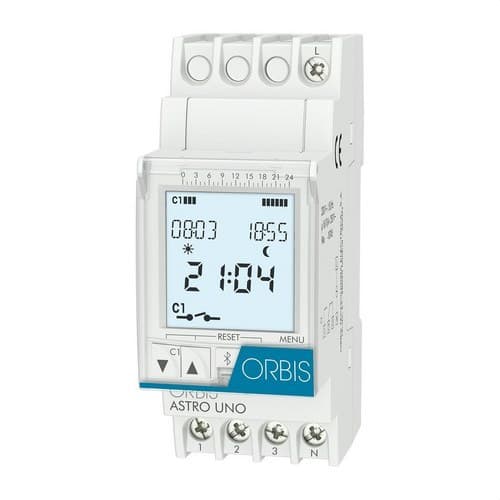
Information about ASTRO UNO 230V Astronomical Time Switch
The Orbis ASTRO UNO astronomical time switch, reference OB178112, is a 230 V digital programmer designed to automate electrical circuits based on the actual sunrise and sunset times for each day of the year. It features one 16(10) A changeover circuit, up to 40 daily or weekly programs, Bluetooth 5 LE communication, and a large backlit LCD display.
Thanks to its astronomical programming, it allows automatic control of outdoor lighting without the need to install a photocell. The unit calculates sunrise and sunset times daily and allows them to be combined with fixed-time operations, corrections of up to ±9 hours and 59 minutes, special periods, and reduction settings. It is especially suitable for public lighting, residential communities, building facades, shop windows, gardens, monuments, and other installations where operating times must adapt to sunrise and sunset.
Automatic astronomical control by sunrise and sunset
The ASTRO UNO automatically calculates the sunrise and sunset times corresponding to each day of the year. In this way, the operating schedule gradually adapts to seasonal changes without the need to manually adjust the programming every few weeks.
This function is especially useful for managing outdoor lighting, as it allows luminaires to switch on when it starts to get dark and switch off when natural light returns, using the astronomical calculations stored in the device itself.
Up to 40 daily or weekly programs
The Orbis ASTRO UNO can store up to 40 programs. Operations can be configured on a daily or weekly basis to adapt the circuit behavior to different days and schedules.
In addition to astronomical sunrise and sunset operations, fixed-time switching operations can also be programmed, allowing both systems to be combined within the same installation.
Astronomical correction of up to ±9 hours and 59 minutes
The calculated sunrise and sunset times can be corrected by up to ±9 hours and 59 minutes. This wide range makes it possible to shift an astronomical operation relative to the calculated theoretical time to suit the specific needs of the installation.
For example, it is possible to program switch-on some time after sunset or bring switch-off forward relative to sunrise without having to replace the astronomical operation with a fixed schedule.
REDUC function to reduce operating hours
The ASTRO UNO includes the REDUC function, designed to set reduction periods within astronomical operation and avoid overlaps between certain astronomical and time-based operations.
This function allows the circuit to be disconnected for part of the night and reactivated later, offering greater flexibility to reduce consumption in installations that do not need to remain on continuously from sunset to sunrise.
Four special periods
The programmer allows up to four periods between two dates with special programming to be defined. Thanks to this function, operation can be temporarily modified during holidays, festive periods, commercial seasons, or other specific times of the year.
This capability gives the ASTRO UNO features close to those of an annual programmer without the need to delete the regular programming.
Bluetooth 5 LE for programming from a mobile device
The current version of the Orbis ASTRO UNO incorporates Bluetooth 5 LE communication, allowing programming via compatible mobile devices and Orbis apps.
Connectivity makes it easy to create and modify schedules from a smartphone or tablet, while still retaining the option to configure the device directly using its buttons and menus.
Backlit LCD display with schedule chart
The ASTRO UNO features a large backlit LCD display with contrast adjustment. The display shows programming information, time, circuit status, and a daily schedule chart that makes it easy to visualize the set operating periods.
The text menus are available in different languages and are designed to make configuration easy directly from the front panel.
Password protection
The keypad can be locked with a password to prevent unauthorized changes to the programming. The unit also includes a sealable transparent cover that physically protects access to the controls.
These features are especially useful in electrical panels in residential communities, public buildings, municipal installations, shops, and other locations accessible to different users.
Operating hours counter
The programmer includes a channel operating hours counter. This information makes it possible to know how long the circuit has been active and can be used as a reference for maintenance, usage analysis, or lighting installation control.
Temporary or permanent manual override
The user can manually change the circuit status without deleting the stored programs. The ASTRO UNO allows temporary manual switching and setting a permanent state when it is necessary to keep the circuit on or off regardless of the programmed schedules.
Automatic summer/winter time change
The clock includes automatic management of the daylight saving time change according to the selected country. This function can be disabled when the installation needs to keep the same time criterion throughout the year.
Backup reserve with replaceable battery
The current generation of the ASTRO UNO uses a replaceable 3 V 220 mAh CR2032 lithium battery. Orbis specifies a backup reserve of up to 5 years with the battery installed and the unit disconnected from the mains.
When the device remains powered, the manufacturer indicates a battery life of up to 10 years. In addition, if the battery is exhausted or absent, a high-capacity capacitor can maintain the programming for approximately 48 hours without power.
16(10) A contact
The ASTRO UNO incorporates a changeover circuit with a capacity of 16(10) A at 250 V AC. The contact uses AgSnO2 material and incorporates zero-cross switching in the current configuration, intended to improve performance with certain electronic loads.
Compatible with different lighting technologies
With zero-cross switching, Orbis specifies the following recommended maximum loads:
- Incandescent lamps: up to 3000 W.
- Fluorescent lamps: up to 1200 VA.
- 12 V AC low-voltage halogen lamps: up to 2000 VA.
- 230 V AC halogen lamps: up to 3000 W.
- Energy-saving lamps: up to 600 VA.
- Downlights: up to 500 VA.
- LED lighting: up to 500 VA.
The actual capacity must always be checked according to the nature of the load and its inrush currents.
Compact 2 DIN module format
The Orbis ASTRO UNO is installed on a DIN rail and occupies only 2 modules, with a width of approximately 35 mm. Its overall dimensions are 35 x 88 x 65 mm and its net weight is 95 g.
Connection is made via screw terminals and accepts rigid or flexible conductors with a cross-section between 1 and 6 mm².
Technical specifications of the Orbis ASTRO UNO OB178112
- Brand: Orbis.
- Reference: OB178112.
- Model: ASTRO UNO.
- Type: digital astronomical time switch.
- Power supply: 230 V AC ±10%.
- Frequency: 50/60 Hz.
- Number of circuits: 1.
- Contact type: changeover.
- Contact material: AgSnO2.
- Breaking capacity: 16(10) A at 250 V AC.
- Zero-cross switching: yes.
- Maximum number of programs: 40.
- Programming: daily and weekly.
- Astronomical operations: sunrise and sunset.
- Fixed-time operations: ON/OFF.
- REDUC function: yes.
- Astronomical operation correction: up to ±9 h 59 min.
- Special periods: 4.
- Manual override: temporary or permanent.
- Summer/winter time change: automatic by country or disableable.
- Communication: Bluetooth 5 LE.
- Display: backlit LCD.
- Daily schedule chart on screen: yes.
- Password lock: yes.
- Channel hours counter: yes.
- Sealable transparent cover: yes.
- Time format: 12/24 hours.
- Switching accuracy: to the second.
- Clock accuracy: ±1 s/24 h at 23 °C.
- Battery: replaceable CR2032 lithium, 3 V and 220 mAh.
- Backup with battery and no mains: up to 5 years.
- Specified battery life with unit powered: up to 10 years.
- Retention without battery or mains: approximately 48 hours.
- Own consumption at 230 V: approximately 1 W (3 VA).
- Maximum incandescent load: 3000 W.
- Maximum fluorescent load: 1200 VA.
- Maximum 12 V AC halogen load: 2000 VA.
- Maximum 230 V halogen load: 3000 W.
- Maximum energy-saving load: 600 VA.
- Maximum downlight load with zero-cross: 500 VA.
- Maximum LED load with zero-cross: 500 VA.
- Mounting: DIN rail.
- Number of modules: 2.
- Dimensions: 35 x 88 x 65 mm.
- Net weight: 95 g.
- Connection: screw terminals.
- Conductor cross-section: 1-6 mm².
- Maximum tightening torque: 0.8 Nm.
- Degree of protection: IP20 according to EN 60529.
- Protection class: Class II under correct mounting conditions.
- Rated impulse voltage: 4 kV.
- Operating temperature: -10 to +55 °C.
- Operating limit temperature: -30 to +55 °C.
- Transport and storage temperature: -35 to +60 °C.
Applications of the ASTRO UNO astronomical switch
The automatic sunrise and sunset calculation makes the ASTRO UNO a particularly suitable solution for circuits whose schedule must follow the evolution of natural light throughout the year:
- Outdoor lighting in residential communities.
- Facade and monument lighting.
- Street and municipal lighting.
- Illuminated signs.
- Shop windows.
- Fountains and gardens.
- Outdoor lighting for factories, hotels, and offices.
- Access points and service areas.
Outdoor lighting control without a photocell
The Orbis ASTRO UNO OB178112 allows lighting operation to be automatically adapted to the daily evolution of sunrise and sunset times. Because it is based on astronomical calculations, it does not need an external light sensor to determine sunrise and sunset.
Its 40 programs, correction of up to ±9 hours and 59 minutes, four special periods, Bluetooth 5 LE, and backlit display offer high flexibility for residential, commercial, and municipal installations where advanced time control is required.
Important: Orbis’s current technical datasheet from July 2026 indicates integrated Bluetooth 5 LE in the ASTRO UNO. Previous commercial documentation referred to an input for an external Bluetooth key, so for this description the manufacturer’s latest official specifications have been used.
