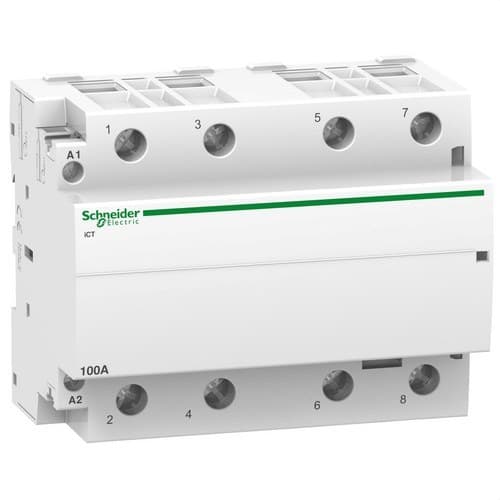
Information about ICT Contactor 100A 4 NO 230/240V AC
The Schneider Electric Acti9 iCT A9C20884 modular contactor is a high-current switching device designed for the remote control of heating circuits and low-inductance loads. It features 4 poles with 4 normally open contacts (4 NO), a rated operational current of 100 A in AC-7A category, and a control coil of 220-240 V AC at 50 Hz. Its modular format allows direct installation on DIN rail in residential, commercial, and small professional electrical panels.
Thanks to its high rated current and four main normally open contacts, the A9C20884 can simultaneously control several power conductors using a single electrical control signal. It is especially suited for applications such as electric heating, resistive loads, HVAC circuits, and other low-inductance loads compatible with the AC-7A utilization category.
100 A Acti9 iCT modular contactor
The A9C20884 reference belongs to Schneider Electric's Acti9 iCT range, developed for automatic or remote electrical switching from modular panels.
Its rated operational current reaches 100 A in AC-7A category, providing a higher switching capacity than standard lower-current modular contactors.
This makes it a suitable solution for significant power circuits where the load is compatible with the utilization category specified by Schneider Electric.
4 poles with 4 normally open contacts
The Schneider Electric A9C20884 has a configuration of 4 poles and 4 normally open contacts.
When the control coil is not energized, the four contacts remain open. When voltage is applied to the control circuit, the contactor acts electromagnetically and closes the four main contacts simultaneously.
This configuration allows multipolar circuits to be controlled from a single command and is especially useful in three-phase systems with neutral and in other circuits requiring four simultaneous power contacts.
220-240 V AC control coil
The A9C20884 coil operates with a control voltage of 220 to 240 V AC at 50 Hz.
This control voltage makes it easy to use directly in many electrical panels powered by conventional low-voltage networks, allowing the load to be controlled by devices such as:
- Thermostats.
- Time switches.
- Control relays.
- Home automation systems.
- HVAC controllers.
- Compatible automation devices.
- Push buttons or maintained control circuits.
The contactor uses a maintained control signal: while the coil remains energized, the power contacts stay in the operating position.
AC-7A utilization category
The rated current of 100 A is specified in AC-7A utilization category according to IEC/EN 61095.
AC-7A is mainly intended for domestic or similar low-inductance loads, such as heating systems and certain resistive or slightly inductive loads.
Typical compatible applications include:
- Electric heating.
- Electric resistors.
- Thermal emitters and systems.
- Certain HVAC circuits.
- Low-inductance loads.
- Power circuits controlled by thermostats or programmers.
No AC-7B rating for motors
It is important to distinguish the AC-7A category from AC-7B. Schneider Electric specifically confirms that the A9C20884 does not have an AC-7B rating.
For this reason, it should not be selected as a contactor for direct motor control based solely on its 100 A rated current.
For motors, pumps, compressors, or machinery with switching requirements specific to motor categories, a contactor specifically sized for that service should be used, such as TeSys range devices corresponding to the load power and utilization category.
400 V AC operational voltage
The power circuit is designed for a rated operational voltage Ue of 400 V AC at 50 Hz.
This feature allows integration into low-voltage distribution circuits, including three-phase configurations, provided that the load and utilization category are compatible with the contactor's characteristics.
500 V insulation voltage
Its main dielectric characteristics include:
- Rated insulation voltage Ui: 500 V AC.
- Rated impulse withstand voltage Uimp: 4 kV.
These values allow the contactor to be integrated into low-voltage electrical panels designed in accordance with the insulation conditions established by the manufacturer.
Remote control of electrical loads
The A9C20884 is designed for remote switching. In this way, a low-power signal applied to the coil can connect or disconnect a considerable power load.
This function is especially useful for automating loads that must be switched according to schedules, temperature, or other system conditions.
For example, the contactor can be used together with a thermostat or time programmer to control a heating circuit without the full load current having to pass directly through the control device contacts.
Mechanical indication of contact status
The contactor includes a mechanical position indicator that allows the switching state to be visually checked from the front of the panel.
This indication makes commissioning, diagnostics, and maintenance easier, allowing the operating status to be seen at a glance.
Low-noise operation
The Acti9 iCT range is designed to offer a reduced noise level during operation, a particularly useful feature when the electrical panel is installed in homes, shops, offices, or other occupied areas.
The front also includes a large area intended for identification and labeling of the controlled circuit.
Mounting on 35 mm DIN rail
The Schneider Electric A9C20884 is designed for clip-on installation on a 35 mm symmetrical DIN rail.
Its modular construction makes it easy to integrate into electrical panels alongside miniature circuit breakers, residual current devices, time switches, relays, and other Acti9 devices.
The contactor occupies 12 x 9 mm pitches, equivalent to a total width of 108 mm or approximately 6 standard 18 mm modules.
A9C20884 dimensions
- Height: 85 mm.
- Width: 108 mm.
- Depth: 60 mm.
- 9 mm pitches: 12.
- Approximate modular equivalent: 6 x 18 mm modules.
- Color: white.
Its modular format allows a 100 A contactor to be installed directly in a DIN rail-compatible panel without the need for special fixing systems.
Power terminals for conductors up to 35 mm²
The power contacts use tunnel terminals designed for large cross-section conductors.
- Power circuit: 1 rigid or flexible conductor from 6 to 35 mm².
- Power circuit tightening torque: 3.5 Nm.
This connection capacity is consistent with the contactor's high rated current and facilitates the use of conductors sized for major power circuits.
Control circuit connections
The control circuit also uses tunnel terminals.
- Rigid conductor: up to 2.5 mm² depending on configuration.
- Flexible conductor: up to 2.5 mm² depending on configuration.
- Control circuit tightening torque: 0.8 Nm.
The installer must respect the conductor sizes, preparation, and tightening torques indicated by Schneider Electric to ensure a safe connection.
Coil consumption
The electromagnetic actuation requires higher power at the moment of pull-in than during contactor holding.
- Apparent power during pull-in: approximately 106 VA.
- Apparent power during holding: approximately 13 VA.
- Thermal dissipation: approximately 4.2 W under specified conditions.
These data are important when sizing control transformers, auxiliary circuits, and devices supplying the coil.
Maximum switching frequency
Schneider Electric specifies for the A9C20884 a frequency of up to 100 switching operations per day.
The product is designed for automatic load switching functions, but the switching frequency expected in the application must remain within the conditions indicated by the manufacturer.
IP20 protection rating
The contactor has an IP20 protection rating according to IEC 60529.
When correctly installed in a suitable modular enclosure, the assembly can reach IP40, depending on the panel design and characteristics.
As a panel component, the A9C20884 is not intended to be installed directly exposed to the environment without an appropriate enclosure.
Operating temperature
The contactor is designed to operate between -5 and 60 °C, with a storage range of -40 to 70 °C.
In installations where the internal panel temperature exceeds 40 °C, the current derating indicated by Schneider Electric must be taken into account.
For 100 A contactors, the range documentation gives reference values of approximately:
- At 40 °C: 100 A.
- At 50 °C: 87 A.
- At 60 °C: 80 A.
Under these conditions, the manufacturer's recommendations for spacing and ventilation must also be observed to avoid excessive heating.
Compatible with Acti9 control auxiliaries
The Schneider Electric A9C20884 can be combined with different control auxiliaries from the Acti9 family to expand the panel's automation possibilities.
Compatible accessories indicated by Schneider Electric include control and signaling devices from the family:
- iACTc.
- iACTp.
- iACTs.
- iATEt.
Exact compatibility must be verified according to the required function and the specific accessory reference.
Applicable standards
The contactor is developed in accordance with the main standards applicable to modular electromechanical contactors for domestic and similar applications.
- IEC 61095.
- EN 61095.
- UTE C 61-481.
Schneider Electric A9C20884 technical characteristics
- Brand: Schneider Electric.
- Reference: A9C20884.
- Range: Acti9.
- Family: iCT.
- Product type: modular contactor.
- Application: heating and low-inductance loads.
- Number of poles: 4P.
- Contact composition: 4 NO.
- Rated operational current: 100 A AC-7A.
- Main utilization category: AC-7A.
- AC-7B rating: no.
- Rated operational voltage Ue: 400 V AC at 50 Hz.
- Control circuit voltage Uc: 220-240 V AC at 50 Hz.
- Control signal type: maintained.
- Control type: remote.
- Rated insulation voltage Ui: 500 V AC.
- Rated impulse withstand voltage Uimp: 4 kV.
- Pull-in consumption: approximately 106 VA.
- Holding consumption: approximately 13 VA.
- Thermal dissipation: approximately 4.2 W.
- Maximum switching frequency: 100 operations/day.
- Mechanical position indicator: yes.
- Mounting: 35 mm symmetrical DIN rail.
- Width: 108 mm.
- Height: 85 mm.
- Depth: 60 mm.
- 9 mm pitches: 12.
- Power terminals: tunnel type.
- Power circuit cross-section: 6-35 mm².
- Power tightening torque: 3.5 Nm.
- Control tightening torque: 0.8 Nm.
- Protection rating: IP20.
- Protection in suitable modular enclosure: up to IP40.
- Operating temperature: -5 to 60 °C.
- Storage temperature: -40 to 70 °C.
- Relative humidity: up to 95% at 55 °C.
- EAN: 3606480375200.
- Standards: IEC 61095, EN 61095 and UTE C 61-481.
High-current contactor for heating and low-inductance loads
The Schneider Electric Acti9 iCT A9C20884 stands out for combining a 100 A AC-7A capacity with a modular DIN rail construction. Its four normally open contacts make it possible to control multipolar circuits from a 220-240 V AC control signal, simplifying the automation of important electrical loads.
Its low-noise operation, mechanical indicator, compatibility with Acti9 auxiliaries, and terminals for power conductors up to 35 mm² make it a particularly practical solution for heating, HVAC, and electrical distribution panels where remote switching is required.
Important: despite its 100 A rated current, the A9C20884 does not have an AC-7B category and Schneider Electric indicates that it must not be used as a motor control contactor. For motors, a contactor specifically sized according to the corresponding power, current, and utilization category must be selected. The contactor also does not replace the overload or short-circuit protection required by the circuit.
