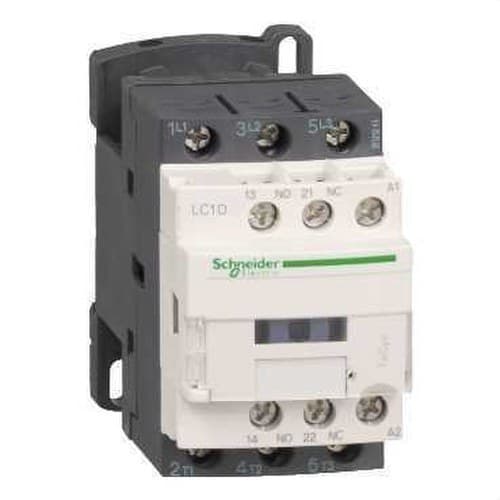
Information about Contactor 12A 1 NO/1 NC 48V 50-60HZ
The Schneider Electric TeSys Deca LC1D12E7 contactor is a power contactor with 3 poles and 3 normally open main contacts, designed for motor control and resistive loads in professional electrical installations. It offers a rated operational current of 12 A in AC-3 and AC-3e categories up to 440 V, allowing it to control motors up to 5.5 kW at 380-400 V, and it is equipped with a 48 V AC control coil at 50/60 Hz.
In addition to the three main power contacts, it includes as standard 2 auxiliary contacts, 1 normally open and 1 normally closed, making it easy to integrate into signaling, interlocking and automation circuits. Its compact 45 mm width, screw terminals and the possibility of mounting on either DIN rail or plate make the LC1D12E7 a versatile solution for motor control panels, machinery and HVAC equipment.
TeSys Deca contactor for motor control
The LC1D12E7 belongs to the Schneider Electric TeSys Deca range, developed for control and switching applications for electrical loads. It is especially suitable for driving three-phase motors through an independent signal applied to its electromagnetic coil.
When the coil receives the 48 V AC control voltage, the three normally open main contacts change state and energize the load. When the control voltage is removed, the mechanism returns the contacts to their rest position and disconnects the power circuit.
12 A in AC-3 and AC-3e categories
Schneider Electric specifies a rated operational current of 12 A up to 440 V for AC-3 and AC-3e categories, mainly intended for motor control.
AC-3 covers common start and stop applications for squirrel-cage motors, while AC-3e meets the requirements defined for modern motor control applications within the conditions indicated by the manufacturer.
Motor up to 5.5 kW at 400 V
In AC-3 category, the permissible motor power varies depending on the supply voltage:
- 220-230 V: up to 3 kW.
- 380-400 V: up to 5.5 kW.
- 415-440 V: up to 5.5 kW.
- 500 V: up to 7.5 kW.
- 660-690 V: up to 7.5 kW.
For a typical 400 V three-phase network, this contactor is therefore ready to switch motors up to 5.5 kW in AC-3, provided that the motor rated current and the rest of the operating conditions are compatible with the device.
Up to 25 A for resistive loads in AC-1
In addition to motor control, the Schneider Electric LC1D12E7 can be used for non-inductive or slightly inductive loads. In AC-1 category it supports a rated operational current of up to 25 A at 440 V and at an ambient temperature of up to 60 °C.
This feature expands its range of applications to electric heating systems, resistors and other loads compatible with AC-1.
48 V AC 50/60 Hz control coil
The E7 suffix identifies in this reference a 48 V AC control coil compatible with 50 and 60 Hz networks.
Using a control voltage lower than the usual power circuit voltage makes it possible to integrate the contactor into automation systems controlled by relays, PLCs, thermostats, pressure switches and other compatible control devices.
3 normally open main contacts
The main circuit has a 3P (3 NO) configuration. The three power poles are normally open when the coil is de-energized and close simultaneously when the contactor receives the closing command.
This configuration is especially suited to switching three-phase loads, allowing all three phases to be opened and closed by a single device.
Integrated auxiliaries 1 NO + 1 NC
In addition to the main contacts, the LC1D12E7 includes as standard two auxiliary contacts: 1 NO + 1 NC.
These contacts can be used for different functions within the control circuit:
- Electrical interlocking of the contactor.
- Status indication.
- Feedback to a PLC or controller.
- Interlocking with other contactors.
- Control of pilot lights and auxiliary devices.
The factory integration allows many automation functions to be carried out without the immediate need to add an external auxiliary block.
Applications in motors, machinery and HVAC
Schneider Electric designs the TeSys Deca range for use in industrial and HVAC applications. The LC1D12E7 reference can be used, within its electrical limits, in equipment such as:
- Three-phase electric motors.
- Pumps and hydraulic units.
- Fans and extractors.
- Air conditioning and ventilation equipment.
- Compressors compatible with its utilization category.
- Industrial machinery.
- Conveyor systems.
- Resistors and electric heating.
- Automation panels.
- Control and switching systems.
Utilization categories AC-1, AC-3, AC-3e and AC-4
Schneider Electric documentation lists the utilization categories AC-1, AC-3, AC-3e and AC-4 for this reference.
For AC-4 applications, characterized by more demanding motor switching, Schneider Electric indicates a reference power of 3.7 kW at 400 V. In this type of application, it is especially important to check the selection tables and the expected switching frequency.
Power circuit up to 690 V AC
The contactor main circuit supports a rated operational voltage of up to 690 V AC, with frequencies from 25 to 400 Hz within the conditions defined by Schneider Electric.
It is also intended for certain DC applications with a main circuit voltage of up to 300 V DC, always respecting the utilization and connection conditions indicated by the manufacturer.
Compact design of only 45 mm width
The Schneider Electric LC1D12E7 combines its power and auxiliary functions in a compact body that makes it easy to integrate into electrical panels with limited space.
- Width: 45 mm.
- Height: 77 mm.
- Depth: 86 mm.
- Net weight: approximately 0.325 kg.
Its 45 mm width allows several contactors and protection devices to be installed while occupying a reduced space inside the cabinet.
Mounting on DIN rail or plate
The LC1D12E7 supports mounting on DIN rail or directly on plate, providing flexibility for the electrical panel designer and installer.
DIN rail mounting is especially convenient for installation alongside motor circuit breakers, thermal overload relays and other modular components used in motor starters.
Screw connection terminals
This reference uses screw terminals for electrical connections. This system provides a robust conductor connection and makes installation, maintenance and tightening checks easier.
Schneider Electric has designed the range to provide front access to both the power connections and the coil and auxiliary contacts, simplifying wiring inside the panel.
High electrical durability
Schneider Electric specifies for the LC1D12E7 a mechanical durability of up to 2 million cycles at 12 A, 440 V and AC-3 category.
This switching capacity makes it suitable for professional applications where the contactor must perform a large number of connections and disconnections throughout its service life, always within the specified electrical and environmental conditions.
IP20 front protection
The front face of the device has an IP20 protection rating according to IEC 60529.
As a component intended for panel mounting, it must be installed inside an enclosure that provides the required degree of protection for the environment and limits access to live parts.
Technical characteristics of the Schneider Electric LC1D12E7
- Brand: Schneider Electric.
- Reference: LC1D12E7.
- Range: TeSys Deca.
- Short name: LC1D.
- Product type: power contactor.
- Application: motor control and resistive loads.
- Number of poles: 3P.
- Main contacts: 3 NO.
- Integrated auxiliary contacts: 1 NO + 1 NC.
- Rated operational current AC-3: 12 A up to 440 V.
- Rated operational current AC-3e: 12 A up to 440 V.
- Rated operational current AC-1: 25 A up to 440 V at 60 °C.
- Motor power at 220-230 V AC-3: 3 kW.
- Motor power at 380-400 V AC-3: 5.5 kW.
- Motor power at 415-440 V AC-3: 5.5 kW.
- Motor power at 500 V AC-3: 7.5 kW.
- Motor power at 660-690 V AC-3: 7.5 kW.
- Motor power at 400 V AC-4: 3.7 kW.
- Coil voltage: 48 V AC.
- Coil frequency: 50/60 Hz.
- Maximum operational voltage AC: 690 V.
- Maximum operational voltage DC: 300 V.
- Utilization categories: AC-1, AC-3, AC-3e and AC-4.
- Terminal type: screw.
- Mounting: DIN rail or plate.
- Front protection rating: IP20.
- Width: 45 mm.
- Height: 77 mm.
- Depth: 86 mm.
- Net weight: approximately 0.325 kg.
- Electrical durability: up to 2 million cycles at 12 A AC-3 and 440 V.
- Main standards: IEC/EN 60947-4-1 and IEC/EN 60947-5-1.
A compact solution for motor control panels
The Schneider Electric TeSys Deca LC1D12E7 combines a current rating of 12 A in AC-3/AC-3e, motor capacity of 5.5 kW at 400 V, three NO main contacts, integrated auxiliaries 1 NO + 1 NC and a 48 V AC coil in a device only 45 mm wide.
The possibility of installing it on DIN rail or plate, its screw connections and its compatibility with motor control and resistive load applications make it easy to integrate into industrial panels, machinery and HVAC systems.
Important: the contactor performs switching functions and does not replace overload and short-circuit protection. In motor applications, it must be combined with a motor circuit breaker, overload relay or properly sized protection devices for the current and characteristics of the installation.
