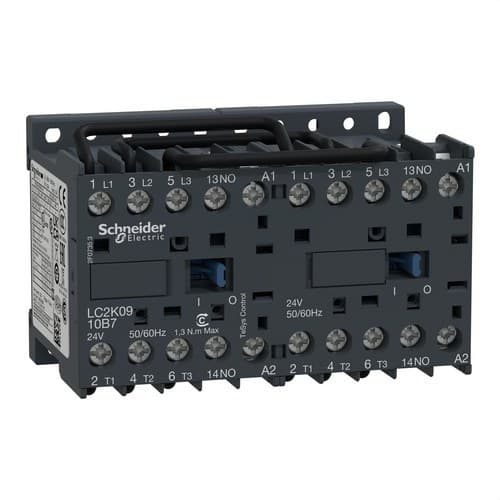
Information about 9A 3P 24V 50-60HZ Mini Inverter Contactor
The Schneider Electric TeSys K LC2K0910B7 reversing mini-contactor is a compact contactor assembly designed to control the direction of rotation of three-phase motors. It features 3 power poles, a rated operational current of 9 A in AC-3/AC-3e category up to 440 V, and a 24 V AC control coil at 50/60 Hz. It is designed to control motors up to 4 kW at 380-415 V and is supplied preassembled with power connections for reversing and mechanical interlocking.
Its TeSys K design makes it possible to build a reversing starter while taking up very little space in the panel. The assembly reverses two phases of the power circuit to change the motor rotation direction, incorporating a mechanical interlock that prevents both contactors from closing at the same time. The main reversing connections are factory prewired in this version with screw terminals, simplifying and speeding up installation.
Reversing contactor for three-phase motors
The LC2K0910B7 is specifically designed for applications where a motor must run in both directions. The assembly consists of TeSys K contactors mechanically coordinated and prepared for phase reversal.
It can be used in applications such as:
- Reversible three-phase motors.
- Conveyor belts.
- Doors and automatic mechanisms.
- Machine tools.
- Compatible lifting systems.
- Conveyors and positioners.
- Industrial machinery.
- Material handling equipment.
- Automation systems requiring direction reversal.
9 A in AC-3 category
Schneider Electric specifies a rated operational current of 9 A up to 440 V in AC-3 category, intended for controlling squirrel-cage motors.
AC-3 category covers contactor closing with the motor starting current and opening when the motor is already running under normal operating conditions.
Current Schneider Electric documentation also includes AC-3e for this family, in addition to AC-1 and AC-4 categories under their respective operating conditions.
Motor up to 4 kW at 400 V
In motor applications, the permissible power depends on the supply voltage. Schneider Electric specifies:
- 220-230 V AC: up to 2.2 kW.
- 380-415 V AC: up to 4 kW.
- 440 V AC: up to 4 kW.
- 500-600 V AC: up to 4 kW.
- 660-690 V AC: up to 4 kW.
On a typical 400 V three-phase network, the LC2K0910B7 is therefore suitable for motors up to 4 kW in AC-3, provided that the rated current, switching duty, and motor starting characteristics are compatible.
24 V AC 50/60 Hz control coils
The B7 suffix identifies the version equipped with 24 V AC control coils at 50/60 Hz.
This voltage allows the reversing starter to be controlled from low-voltage control circuits using devices such as:
- Forward and reverse pushbuttons.
- Relays.
- Limit switches.
- Programmable logic controllers.
- Timers.
- Machine controllers.
- Other control devices compatible with 24 V AC.
Direction reversal by phase swapping
To reverse the direction of rotation of a three-phase motor, two of its phases must be swapped. The LC2K0910B7 incorporates factory prewired power circuit reversing connections, reducing the number of links the installer must make.
When one contactor is energized, the motor receives the phase sequence corresponding to one direction of rotation. When the opposite contactor is energized, two phases are swapped and the motor rotates in the opposite direction.
Integrated mechanical interlock
The assembly includes a mechanical interlock between the two contactors. Its function is to physically prevent both from closing simultaneously.
This function is essential in a reversing starter, since simultaneous activation of both contactors could create a phase-to-phase short-circuit condition.
Schneider Electric specifies that the assembly includes mechanical interlocking, but no built-in electrical interlocking. The control circuit must be designed with the necessary logic and auxiliary contacts to also prevent simultaneous electrical commands.
Factory prewired power connections
One of the main advantages of this reference is that it is supplied preassembled with bars and power connections for the reversing function.
This helps reduce:
- Wiring time.
- The number of links made by the installer.
- The risk of phase reversal errors.
- The space required compared with solutions built with separate components and conventional wiring.
3 normally open main poles
The contactors that make up the assembly use a power configuration of 3 poles with normally open contacts, intended for simultaneous switching of the motor’s three phases.
When the corresponding coil is de-energized, the power contacts remain open. When a start command is received, the selected contactor closes its three poles and supplies the motor with the corresponding phase sequence.
Auxiliary contact for control circuits
The assembly includes auxiliary contacts associated with contactor operation, which can be used in signaling and interlocking circuits.
These contacts are especially important for implementing cross electrical interlocking between forward and reverse commands, complementing the built-in mechanical interlock.
Up to 20 A for AC-1 loads
In addition to motor control, the TeSys K range supports certain resistive loads. For this reference, Schneider Electric specifies an operational current of up to 20 A in AC-1 category at voltages up to 440 V, under the thermal conditions established by the manufacturer.
This value should not be confused with the 9 A in AC-3, since both categories represent different load types and switching requirements.
AC-1, AC-3, AC-3e and AC-4 utilization categories
The LC2K0910B7 is mainly intended for motor control, although Schneider Electric covers different utilization categories:
- AC-1: resistive or slightly inductive loads.
- AC-3: normal starting and stopping of squirrel-cage motors.
- AC-3e: updated category for certain motor applications.
- AC-4: motor applications with especially demanding switching, such as rapid reversing or inching.
The permissible current and electrical life depend on the utilization category and the switching frequency.
Power circuit up to 690 V AC
The main circuit is designed for a rated operational voltage of up to 690 V AC at 50/60 Hz.
Its dielectric characteristics include:
- Rated insulation voltage Ui: 690 V according to IEC 60947.
- Rated impulse withstand voltage Uimp: 8 kV.
- Overvoltage category: III.
Screw terminals
The Schneider Electric LC2K0910B7 uses screw terminals for electrical connections.
Depending on the conductor type and number of wires, it accepts sections such as:
- Rigid conductor: 1.5 to 4 mm².
- Flexible conductor without ferrule: 0.75 to 4 mm².
- Flexible conductor with ferrule: 0.34 to 2.5 mm².
- Tightening torque: approximately 0.8-1.3 Nm.
Connections must be made in accordance with the sections and tightening torques specified by Schneider Electric.
Especially compact format
The TeSys K family is designed for applications where panel space is limited. The reversing assembly has approximate dimensions of:
- Width: 90 mm.
- Height: 58 mm.
- Depth: 57 mm.
- Weight: approximately 0.39 kg.
Its 90 mm width corresponds to the complete preassembled reversing assembly.
Mounting on DIN rail or plate
The LC2K0910B7 can be installed in two ways:
- On DIN rail.
- By screw fixing on a plate.
This flexibility allows it to be integrated into modular panels as well as automation and machinery enclosures.
High durability
Schneider Electric specifies for this assembly:
- Mechanical durability: up to 5 million cycles.
- Electrical durability: approximately 1.3 million cycles at 9 A in AC-3.
In AC-3 applications, Schneider Electric describes the assembly as suitable for switching frequencies of up to approximately 600 cycles per hour within the specified conditions.
Coil consumption
For the AC coil, approximately:
- Inrush power: 30 VA.
- Holding power: 4.5 VA.
- Thermal dissipation: approximately 1.3 W.
These values should be taken into account when sizing the transformer or auxiliary control circuit.
Fast operating times
The electromagnetic mechanism has short switching times:
- Coil energization and NO contact closing: approximately 10-20 ms.
- De-energization and NO contact opening: approximately 10-20 ms.
The motor reversing sequence must be designed with the necessary timing and safety conditions to avoid reversals that could mechanically damage the load.
IP20 protection rating
The assembly has an IP20 protection rating in accordance with Schneider Electric requirements.
As a panel component, it must be installed inside an enclosure suitable for the environment to provide the necessary protection against contact, dust, moisture, and other external conditions.
Operating temperature
The LC2K0910B7 is designed to operate in an ambient temperature range of -25 to 50 °C under its rated conditions.
For storage, Schneider Electric specifies temperatures of approximately -50 to 80 °C.
It can operate at altitudes of up to 2,000 m without derating, according to the manufacturer’s data.
Applications of the Schneider Electric LC2K0910B7
Its compact reversing design makes it suitable for many automation installations:
- Reversing three-phase motors.
- Bidirectional conveyor belts.
- Forward/reverse travel machines.
- Industrial doors and gates.
- Positioning systems.
- Handling equipment.
- Compact industrial machinery.
- Automation panels.
- Small reversible pumping systems where the application allows it.
Technical characteristics of the Schneider Electric LC2K0910B7
- Brand: Schneider Electric.
- Reference: LC2K0910B7.
- Range: TeSys.
- Family: TeSys K.
- Short name: LC2K.
- Type: reversing contactor / reversing mini-contactor.
- Main application: motor control and reversing.
- Number of poles: 3P.
- Power contacts: 3 NO per contactor.
- Rated current AC-3/AC-3e: 9 A up to 440 V.
- AC-1 current: up to 20 A under specified conditions.
- Motor power at 220-230 V: 2.2 kW.
- Motor power at 380-415 V: 4 kW.
- Motor power at 440 V: 4 kW.
- Coil voltage: 24 V AC.
- Coil frequency: 50/60 Hz.
- Maximum power circuit voltage: 690 V AC.
- Rated insulation voltage Ui: 690 V according to IEC.
- Rated impulse withstand voltage Uimp: 8 kV.
- Utilization categories: AC-1, AC-3, AC-3e and AC-4.
- Mechanical interlock: included.
- Electrical interlock: must be implemented through the corresponding control circuit.
- Power reversing connections: factory prewired.
- Terminals: screw.
- Mounting: DIN rail or plate.
- Coil inrush power: approximately 30 VA.
- Holding power: approximately 4.5 VA.
- Mechanical durability: up to 5 million cycles.
- Electrical durability: approximately 1.3 million cycles at 9 A AC-3.
- Protection rating: IP20.
- Operating temperature: -25 to 50 °C.
- Altitude without derating: up to 2,000 m.
- Width: 90 mm.
- Height: 58 mm.
- Depth: 57 mm.
- Weight: approximately 0.39 kg.
- EAN: 3389110492286.
- Main standard: IEC/EN 60947-4-1.
Compact solution for reversing motors up to 4 kW
The Schneider Electric TeSys K LC2K0910B7 makes it possible to reverse the direction of three-phase motors up to 4 kW at 400 V using a compact, preassembled assembly ready for direct panel mounting. Its 9 A in AC-3, 24 V AC coils, and factory prewired reversing connections reduce the work needed to build a reversing starter.
The integrated mechanical interlock increases switching safety by preventing both contactors from closing simultaneously, while the 90 mm width makes installation easier in panels with limited space.
Important: the LC2K0910B7 performs switching and reversing functions, but does not replace motor short-circuit and overload protection. It must be combined with a motor protection circuit breaker, fuses, thermal overload relay, or other properly sized devices. In addition to the built-in mechanical interlock, the control circuit must be designed with the appropriate electrical interlocking to prevent simultaneous forward and reverse commands.
