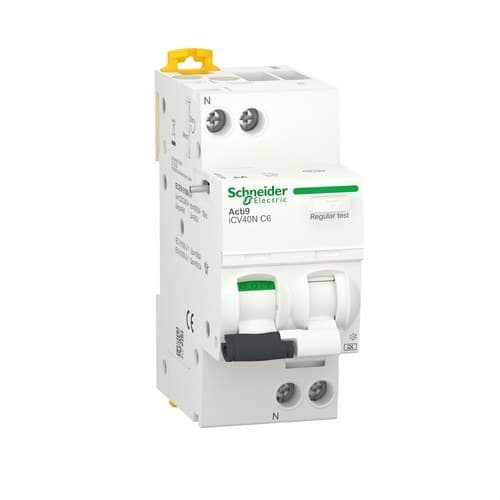
Information about ICV40N Differential 1P+N C 10A 300mA Class ASI
The Schneider Electric Acti9 iCV40N A9DF7610 is a 1P+N combined residual current circuit breaker with overcurrent protection (RCBO), 10 A, C curve, and 300 mA residual current sensitivity. It integrates in a single device both magnetothermal protection against overloads and short circuits and residual current protection against earth leakage currents, reducing the space required in the panel and simplifying the protection of single-phase circuits.
This reference includes superimmunized type A-SI residual current protection, specially developed to provide greater immunity against electrical disturbances and reduce the risk of nuisance tripping. It features a rated breaking capacity Icn of 6 kA at 230 V AC, instantaneous residual current operation, DIN rail mounting, and VisiTrip and VisiSafe signaling technologies.
Magnetothermal and residual current protection in a single device
The A9DF7610 combines the functions traditionally performed by separate miniature circuit breakers and residual current devices.
Its main protection functions are:
- Protection against overloads: limits the effects of currents above the rated value maintained for a prolonged period.
- Protection against short circuits: acts quickly when high fault currents occur.
- Protection against earth leakage: continuously monitors current imbalance between phase and neutral.
- Protection against fire risk associated with leakage currents: thanks to its 300 mA residual current sensitivity.
- Protection against indirect contact: within the conditions established by the installation and applicable regulations.
Integrating all these functions in an RCBO makes it possible to provide independent protection for each circuit and avoids a fault on one line necessarily affecting other circuits protected by different devices.
1P+N with one protected pole
The Schneider Electric A9DF7610 has a 1P+N configuration. The device has two total poles and one pole protected against overcurrent, corresponding to the phase, together with the associated neutral pole.
This configuration is intended for single-phase circuits and allows phase and neutral to be disconnected together when the device operates.
Rated current of 10 A
The rated current In is 10 A. This value determines the current for which the magnetothermal protection is designed under the conditions specified by Schneider Electric.
The 10 A rating can be used in properly sized circuits whose design current is compatible with this rated current. Final selection must be made taking into account conductor cross-section, load type, installation conditions, and regulatory requirements.
C curve for loads with moderate inrush currents
The magnetothermal protection uses a C tripping curve, one of the most widely used configurations in general distribution circuits.
Schneider Electric specifies a magnetic tripping threshold of approximately 5 to 10 times the rated current.
The C curve allows certain transient inrush currents to be withstood without causing unnecessary instantaneous tripping, making it suitable for:
- Lighting circuits.
- Small inductive loads.
- Electronic equipment.
- Compatible small motors.
- Auxiliary circuits.
- Commercial installations.
- General distribution circuits.
300 mA residual current sensitivity
The A9DF7610 incorporates a residual current sensitivity IΔn of 300 mA.
This sensitivity is mainly intended for protection against indirect contact and fire risk associated with leakage currents, depending on the characteristics and protection scheme of the installation.
Important: a 300 mA residual current device should not be confused with a 30 mA one. The 30 mA sensitivity is commonly used when additional protection for people against certain electric shock risks is required. Selection must be made in accordance with applicable regulations and the specific design of the installation.
Superimmunized type A-SI residual current protection
The Schneider Electric A9DF7610 uses type A-SI residual current protection. The SI designation refers to Schneider Electric’s Super Immunised technology.
Type A can detect sinusoidal alternating residual currents and pulsating direct residual currents. A-SI technology adds greater immunity against electrical disturbances that can cause nuisance tripping in conventional devices.
This feature is especially useful in installations with:
- Electronic equipment.
- Switched-mode power supplies.
- LED lighting.
- Computer equipment.
- Automation systems.
- Loads that generate harmonics.
- Environments where frequent electrical disturbances may occur.
Schneider Electric also highlights the suitability of type A-SI for polluted or corrosive environments within the environmental conditions specified by the manufacturer.
Greater immunity against nuisance tripping
One of the main advantages of A-SI technology is its greater resistance to transient disturbances.
The range documentation specifies for A-SI versions a withstand capability against impulse currents of up to 3 kA according to the 8/20 µs waveform.
This feature helps maintain service continuity when certain electrical transients occur that could cause unnecessary operation of a conventional residual current device.
6 kA breaking capacity
The Acti9 iCV40N A9DF7610 offers a rated breaking capacity Icn of 6,000 A at 230 V AC in accordance with EN/IEC 61009-2-1.
Schneider Electric also specifies a service breaking capacity Ics of 6 kA, equivalent to 100% of Icn under the conditions defined by the standard.
The breaking capacity must always be equal to or greater than the prospective short-circuit current at the installation point.
Limiting class 3
The RCBO has a limiting class 3 in accordance with EN/IEC 61009-2-1.
Current limiting reduces the energy that passes through the circuit during a short circuit, helping to reduce the thermal and electrodynamic stresses on downstream conductors and equipment.
Voltage-independent residual current operation
Schneider Electric specifies a voltage-independent residual current tripping technology.
This feature allows the fundamental residual current protection function to operate without relying on externally powered electronics to detect residual current within the conditions intended by the manufacturer.
Instantaneous residual current operation
The residual current protection is instantaneous, meaning it does not include an intentional tripping delay.
When the residual current reaches the specified operating conditions, the device disconnects the circuit without applying an additional selective delay.
230 V AC rated voltage
The A9DF7610 is designed for single-phase circuits with the following characteristics:
- Rated operational voltage Ue: 230 V AC.
- Frequency: 50/60 Hz.
- Rated insulation voltage Ui: 400 V AC.
- Rated impulse withstand voltage Uimp: 4 kV.
- Overvoltage category: III.
VisiTrip for quick fault identification
The RCBO integrates VisiTrip technology, designed to facilitate diagnosis after a trip.
The front indicators help quickly identify that the circuit has tripped and allow certain device states to be visually distinguished, reducing the time needed to locate an issue inside the electrical panel.
VisiSafe to check contact opening
VisiSafe technology incorporates a green indicator that allows the physical opening of the contacts to be visually checked.
This feature facilitates subsequent maintenance operations and is complemented by the device’s suitability for isolation functions in accordance with EN/IEC 61009-2-1.
DIN rail mounting
The Schneider Electric A9DF7610 is designed for clip-on installation on a DIN rail.
Its width is 36 mm, equivalent to:
- 4 x 9 mm modules.
- 2 standard 18 mm modules.
By combining magnetothermal and residual current protection in only two modules, it helps optimize the available space inside the electrical panel.
Compact dimensions
- Width: 36 mm.
- Height: approximately 85 mm.
- Depth: approximately 73 mm.
- Installation depth: approximately 44 mm.
- Weight: approximately 210 g.
- Color: white RAL 9003.
Connection via screw terminals
The device uses terminals designed to provide a secure connection for electrical conductors.
Schneider Electric specifies a tightening torque of approximately 2 Nm. The conductor cross-sections used must comply with the limits indicated by the manufacturer and the electrical sizing of the circuit.
Compatible with Acti9 distribution and auxiliary systems
The Acti9 iCV40N can be integrated with different distribution and auxiliary solutions from the Acti9 family.
The manufacturer’s documentation includes compatibility with:
- Electrical auxiliaries.
- Signaling accessories.
- Trip auxiliary devices.
- Compatible comb busbars and distribution systems.
- Wireless sensors compatible with certain Acti9 configurations.
Exact compatibility must be verified for each accessory reference before installation.
IP20 protection
The A9DF7610 has an IP20 protection rating as a standalone device in accordance with IEC 60529.
When correctly installed in a suitable modular enclosure, the assembly can achieve a protection rating of up to IP40, depending on the characteristics of the panel.
Wide operating temperature range
The device is designed to operate within a temperature range of:
- Operating: -25 to 60 °C.
- Storage: -40 to 85 °C.
- Relative humidity: up to approximately 95% within the indicated conditions.
- Operating altitude: up to approximately 2,000 m.
High electrical and mechanical durability
Schneider Electric specifies for this model:
- Mechanical durability: up to 20,000 cycles.
- Electrical durability: up to 20,000 cycles.
These performance levels make it suitable for electrical panels subject to normal service, testing, and maintenance operations.
Applications of the Schneider Electric A9DF7610
The combination of magnetothermal and residual current protection makes the A9DF7610 suitable for numerous single-phase circuits where independent protection and space savings are required.
Possible applications include:
- Single-phase distribution circuits.
- Commercial installations.
- Retail premises.
- Offices.
- Auxiliary panels.
- Circuits with electronic equipment.
- Installations requiring greater immunity against nuisance tripping.
- Circuits requiring 300 mA residual current protection.
The specific use must always be determined in accordance with the earthing system, applicable electrical regulations, the function of the circuit, and the required level of residual current protection.
Schneider Electric A9DF7610 technical characteristics
- Brand: Schneider Electric.
- Reference: A9DF7610.
- Range: Acti9.
- Model: iCV40N.
- Type: combined residual current circuit breaker with overcurrent protection (RCBO).
- Configuration: 1P+N.
- Total number of poles: 2.
- Overcurrent-protected poles: 1.
- Rated current In: 10 A.
- Magnetothermal curve: C.
- Magnetic threshold: approximately 5-10 x In.
- Residual current sensitivity IΔn: 300 mA.
- Residual current class: type A-SI.
- SI technology: superimmunized.
- Residual current time delay: instantaneous.
- Residual current tripping technology: voltage-independent.
- Rated operational voltage Ue: 230 V AC.
- Frequency: 50/60 Hz.
- Breaking capacity Icn: 6 kA at 230 V AC.
- Service breaking capacity Ics: 6 kA, 100% of Icn.
- Limiting class: 3.
- A-SI impulse current withstand: up to 3 kA.
- Rated insulation voltage Ui: 400 V AC.
- Rated impulse withstand voltage Uimp: 4 kV.
- Overvoltage category: III.
- VisiTrip: yes.
- VisiSafe: yes.
- Contact position indicator: yes.
- Suitable for isolation: yes.
- Mounting: DIN rail.
- Width: 36 mm.
- Modular width: 2 x 18 mm modules.
- 9 mm steps: 4.
- Height: approximately 85 mm.
- Depth: approximately 73 mm.
- Installation depth: approximately 44 mm.
- Weight: approximately 210 g.
- Tightening torque: 2 Nm.
- Protection rating: IP20.
- Protection in modular enclosure: up to IP40.
- Operating temperature: -25 to 60 °C.
- Storage temperature: -40 to 85 °C.
- Mechanical durability: up to 20,000 cycles.
- Electrical durability: up to 20,000 cycles.
- Main standard: EN/IEC 61009-2-1.
- EAN: 3606489444457.
Combined and superimmunized protection in just 2 modules
The Schneider Electric Acti9 iCV40N A9DF7610 combines overload, short-circuit, and leakage current protection in a single compact device. Its 1P+N configuration, 10 A rating, C curve, 300 mA sensitivity, and A-SI technology make it suitable for protecting single-phase circuits while reducing the space occupied in the panel.
The 6 kA breaking capacity, VisiTrip and VisiSafe technologies, improved immunity against disturbances, and DIN rail mounting make this RCBO a particularly practical solution for commercial and professional panels where individual circuit protection and greater service continuity are required.
Important: as this is a 300 mA RCBO, its residual current function should not be equated with the 30 mA additional protection commonly used for certain personal protection applications. The appropriate residual current sensitivity must be selected according to the regulations, the earthing system, and the specific characteristics of each circuit.
